Understanding EV Motors: Types and How They Work
Wouter Smit ·
Listen to this article~5 min

EV motors have just one moving part, but don't let that fool you. The three main types each work differently to power your electric vehicle efficiently and reliably.
You know, when I first heard that electric vehicle motors have only one moving part, I thought, 'Wow, that's got to be simple.' But then I started digging into how they actually work, and let me tell you, these things are far from basic. They're engineering marvels that make your EV zip down the road almost silently.
Think about it this way - it's like comparing a Swiss watch to a sundial. Both tell time, but one's got hundreds of tiny pieces working in perfect harmony while the other just... sits there. EV motors might have that single moving part, but what happens around it is where the magic happens.
### The Three Main Types of EV Motors
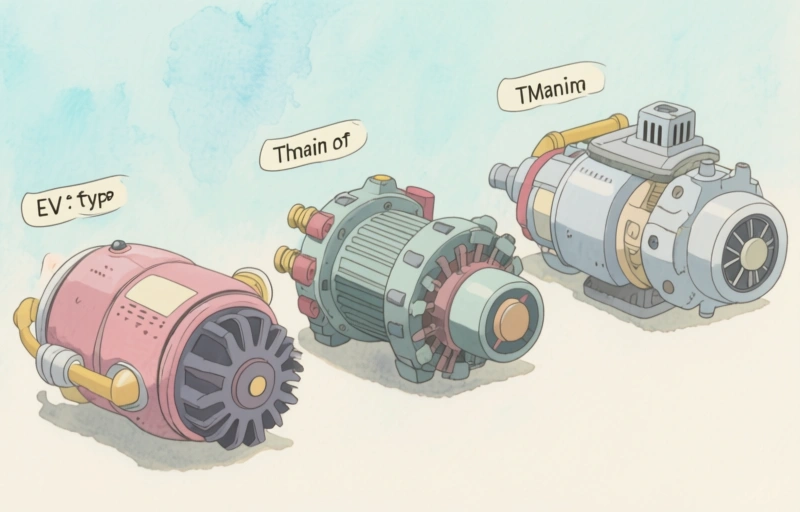
So here's where it gets interesting. There are three main types of motors you'll find in electric vehicles today, and each has its own personality, its own way of doing things. I like to think of them as different characters in a story - each playing their role in the EV revolution.
First up, we've got the AC Induction Motor. This is the old reliable, the workhorse that Tesla used in their early models. It doesn't use permanent magnets, which means it's cheaper to make. The downside? It's not quite as efficient at lower speeds, kind of like how some cars guzzle more gas in city traffic.
Then there's the Permanent Magnet Synchronous Motor. This one's become really popular lately because it's super efficient. Most newer EVs use this type. It's like that friend who's always optimized - gets the most out of every bit of energy. The catch is it uses rare earth magnets, which can be pricey and have some environmental concerns.
Last, we have the Switched Reluctance Motor. This is the newcomer, the underdog trying to make a name for itself. It's simple and rugged, doesn't need those expensive magnets, but it can be a bit noisier and less smooth. It's like the reliable pickup truck of EV motors - not fancy, but gets the job done.
### How These Motors Actually Move Your Car
Here's what blows my mind - all three types work on the same basic principle, but they execute it differently. They use electromagnetic fields to create rotation. When electricity flows through coils around the motor, it creates magnetic fields that push and pull against each other.
It's like having invisible hands spinning a wheel, except these hands are magnetic fields created by carefully controlled bursts of electricity. The motor controller is the brain here, deciding exactly when to send power to which part of the motor to keep everything spinning smoothly.
What's really cool is how efficient this all is. While a typical gasoline engine wastes about 60-70% of its energy as heat, EV motors convert about 85-90% of electrical energy into motion. That's why you can drive an EV for about $0.04 per mile when electricity costs around $0.13 per kWh, compared to about $0.15 per mile for a gas car getting 25 MPG with gas at $3.75 per gallon.
### Why This Matters for EV Owners
You might be wondering, 'Okay, but why should I care what type of motor is in my EV?' Well, it actually affects your driving experience more than you might think.
- **Performance**: Permanent magnet motors usually give you that instant torque feeling - that push-you-back-in-your-seat acceleration EVs are famous for
- **Range**: More efficient motors mean you can go farther on the same battery charge
- **Cost**: Different motor types affect both the upfront price and long-term maintenance costs
- **Reliability**: Simpler designs with fewer parts tend to last longer with fewer issues
I remember talking to an engineer who put it perfectly: 'We're not just replacing engines with motors. We're rethinking how vehicles move from the ground up.'
### The Future of EV Motor Technology
Here's where things get really exciting. Companies are working on next-generation motors that could be even more efficient, cheaper, and more powerful. Some are experimenting with motors that don't use any rare earth materials at all, which could solve both cost and environmental issues.
Others are working on integrating the motor directly into the wheel - what they call 'in-wheel motors.' Imagine each wheel having its own motor, controlled independently by the car's computer. The handling possibilities are mind-boggling.
What's clear is that we're just at the beginning of this electric motor evolution. The basic principle might stay the same, but how we implement it keeps getting smarter, more efficient, and more innovative.
So next time you're driving or riding in an EV, take a moment to appreciate that quiet hum. There's a lot of clever engineering making that smooth ride possible - and it all starts with understanding that while EV motors might seem simple on the surface, they're anything but ordinary.